Monday, 1 June 2020

After George Floyd, what next?

The death of George Floyd in Minneapolis leaves me with a welter of emotions: shock, horror, anger, shame, confusion… There are now so many strident voices clamouring for attention following this brutal act that I have wondered whether it is worth saying anything at all. Yet I feel I must, for silence is the greatest evil of all.

Having been brought up in a white minority of 2% in Trinidad and Tobago, I never experienced racial hatred, and for that, I want to say thank you to my friends, acquaintances and parishioners. Trinidad is not perfect; nowhere is, but the love, care and respect which I was always shown humbles me. Fast forward many years to the Vaal south of Johannesburg, in Sebokeng and Sharpeville, we were the only white people, loved, cared for, never mistreated, never laughed at or mocked. Yes, I know we were in positions of so-called authority but truly it wasn’t about power.

Why is it then that my own ‘white race’ finds it so hard to love ‘the other’, to speak with grace, to care regardless of circumstances? I know the history as well as the next person, and am not racked with liberal pseudo-guilt. It does astonish me that some of ‘my people’ can be so ignorant, so afraid of those who aren’t like them.

I was asked the other day whether I had ever preached against racism, and can truly say that I’ve done that with some frequency over the years. That doesn’t let me off the hook, for it’s easy to say that racism is wrong, evil, pointless and stupid. It’s less easy to let go of my own desire to be right, to be superior, to be in charge, to control and order others, and really hard to stop framing other people in the narrow perspective of my little insight.

So I’m not writing this to assuage some supposed human guilt lurking in the corners of my heart. I just needed to say thank you to all my friends for letting me be me, letting me be different, letting me into your lives even though you were ‘not like me’. In the middle of a coronavirus epidemic, I needed to ask why we are more afraid of dying of that virus than of poisoning each other with the virulence of hatred of the other. I needed also to say, as a Christian, that I really believe that in Christ there is no inferior other, male, female, Jew, Gentile, slave, free, but all are called to be one, in Christ.

Friday, 27 March 2020

How gentle should I be?


A few days ago I found myself thinking about how unkind people can be on Facebook and Twitter, even in these trying times. While musing on this, I thought of the word ‘gentleness’ as a possible descriptor of the tone we should adopt in our instant and sometimes unreflective comments. One thing led to another, and I found myself reading Paul’s imperative in Philippians 4.5 ‘Let your gentleness be known to everyone’. 

So here Paul is encouraging us to extravert our gentleness, to make it public, and I guess that social media are contexts as good as any for doing that. The only problem is that it’s not immediately clear what is meant by gentleness, as the range of words in English translations demonstrates:

Gentleness: NRSV/NIV
Softness: Tyndale/Coverdale
Patience: Wyclif [or temperance]
Patient mind: Geneva/Bishops’ Bible
Forbearance: RV/RSV
Modesty: Vulgate/Douay-Rheims [Latin modestia]

And to cap it all, Eugene Peterson in the Message shows the difficulty by using a sentence to translate a word: “Make it as clear as you can to all you meet that you’re on their side, working with them and not against them.”

The next task was to turn to the Greek word. The abstract noun is ἐπιείκεια, the adjective ἐπιεικής [epieikeia and epieikēs]. In classical Greek, it is ‘an expression for balanced and decent behaviour’[1] on the part of the gods (though the Greek gods didn’t always behave like this) or on the part of human beings. You could say that it is fitting or appropriate behaviour, that matches the way the world is designed to work. In the Septuagint (Greek version of what Christians call the Old Testament) it often refers to the qualities of God’s own kingship, which caught my attention. 

One of the specific uses of the word relates to the courts of law, in which the king, or the judge, is prepared to “mitigate the rigours of justice, with its laws and claims, in contrast to the attitude that demands that rights, including one’s own, should be upheld at all costs.”[2] This links closely with the word ‘forbearance’, used in the 19th century Revised Version (1885) and the mid-20th century RSV and I think sadly lost in the NRSV and NIV. One of the 9 definitions of ‘forbear’ in the OED is “To abstain from injuring, punishing, or giving way to resentment against (a person or thing); to spare, show mercy or indulgence to.” It’s a rare use, almost obsolete, but it is at the heart of the English word, and perhaps of the Greek too. It describes for me a God who holds back and acts justly by not ‘throwing the book at the malefactor’. It makes space for forgiveness, and in the great dispensation of God, it makes space for the price to be paid by another.

So then I came to its infrequent use in the New Testament. In 2 Corinthians 10.1 Paul appeals to the Corinthians ‘by the meekness and gentleness of Christ’ [NRSV], implying that that is the behaviour expected of the body of Christ. Other uses reinforce this: 1 Timothy 3.3 describes the character of the bishop as ‘gentle’ among other things, and James 3.17 has gentleness as one of the features of the ‘wisdom from above’. In short, ἐπιεικής is what God is, and what we are called to be in Christ as church or as leaders in the church. 

Perhaps then all of the English words listed above work in collaboration with one another. We have an ἐπιεικής God who is always on our side. Eugene Peterson gets that right. God forbears us, bears with our sins, weaknesses and imperfections, showing mercy and at the right time sending his Son to stand in our place. This is a God who makes room for us, a ‘soft’ or gentle God, forgiving, not holding our transgressions against us.

So back to my starting point. Because God in Christ is like that towards us, so we who are now in Christ can be like that both towards our sisters and brothers in Christ, and indeed towards the whole of humanity. The gospel is acted out through us every time we are forbearing, gentle, or of patient mind. As for modesty, well, I’m not sure about that one, but there’s no harm in being modest too!


[1]      Moises Silva, New International Dictionary of NT Theology and Exegesis 2:240-41
[2]      Moises Silva, ibid

Sunday, 8 December 2019

Jill and Adrian Chatfield's 2019 news

2019 was the year Adrian turned 70! We went to Prague and Budapest in March to celebrate, continuing the tradition of exploring new European cities. It was slightly marred by Jill tripping and falling on a very uneven pavement in Prague, and she was blue-lighted to the University Hospital. Two and a half hours later, she had received CT scan and emergency treatment, and we were back out on the pavement. Very impressed, not least by the ambulance equipped with a card machine for payment.

Adrian had always wanted to be listed as a MV70, male veteran for the uninitiated. So he ran the Edinburgh Marathon for the Alzheimer's Society in May, and then his usual Yorkshireman Fell Marathon in September. Both were harder work, no doubt because of the new decade. He keeps thinking that it's time to reduce to half marathons, but time will tell. 

Continuing on the theme of time away from home, we actually spent twelve weeks out and about. In January we were delighted and privileged to hold the fort in six rural churches in County Donegal for a good friend. Visiting Derry/Londonderry for the first time made us more than ever aware of just how complex politics is, and what a mess the Brexit negotiations have made of the Good Friday Agreement. We missed a car bomb by one day, but the thing that will stay with us is wonderful Irish hospitality, some very moving opportunities for ministry and lots of exploring. A Friday night's healing service at Malin, attended by Anglicans, Presbyterians and Catholics was for
us the highlight, not least because everyone came forward for prayer.

The centrepiece of our caravanning was five weeks in France, which took us to Amiens, the Loire (Checy), Orleans, Vezelay, Chambery and Bourg-St-Maurice. We are not now able to do as much steep walking as formerly, but a mixture of art galleries, country walks and the occasional foray into the foothills is deeply satisfying.

When we are not playing, we keep ourselves pretty busy. Adrian gives spiritual direction and speaks at a number of retreats. Jill does voluntary chaplaincy in the Emergency Department at Queen's Medical Centre once a week and occasional bank chaplaincy at Queen's and City Hospitals, and we both help out in our local church: St Laurence Heanor. Adrian's second ever book came out in September, co-authored with a former student. 'Soul Friendship: A Practical Theology of Spiritual Direction' seems to have been well-received by people whose opinion we trust.

For those who know our wider family, Michael is now a Chaplain in the Royal Navy, having moved from the RAF and Helen continues with Youth and Children's work in a multi-parish benefice in rural Hampshire. Rachel and Dave are settled in Occupational Therapy and Electrical Services respectively. Our four granddaughters are now 19, 17, 15 and 12. That's what makes us feel really old, but we are delighted that Hannah (19) has come to the University of Nottingham to read Global Issues and International Affairs, so we are really enjoying getting to know her as an adult.

We're writing this in the tradition of the 'Christmas letter' and are grateful that we get news back from so many of our friends. But we are intensely aware, writing this in the week of the third General Election, that we live in unpredictable, politically foolish and troubling times. So our prayer for all our family and friends is  that you may find peace in the midst of uncertainty, hope among deeply conflicted proposals for the future, and - if you are a Christian - enduring faith in Jesus, our Lord and Saviour.

Friday, 30 August 2019

The end draweth nigh: Brexit?


It came to me in a moment of idle speculation: October 31st is the end of the world, at least as we know it. I’d be hard pressed to foretell the outcome. Political commentators predict chaos if they are remainers, or a little pain for a better world (exiters). The millennium – and dire consequences for unbelievers – has been prophesied for the past 2000 years and longer. Norman Cohn in his classic ‘The Pursuit of the Millennium’ unfolds the European predilection for a politics of disaster leading to a new golden age, often with the elimination of those with uncomfortably distinct views.

On the one hand, the truth is that November 1st will probably be a dull and rainy day. November as usual, then. What none of us can tell is the consequence of reversing an incompletely thought through political project: the European Union. Born out of the horror of European and global conflict, it always had a millennial tone: the new age dawns. It also had a crusading tone: together we can correct the imbalance of power, lest America and the USSR dominate the global economy.

On the other hand, it is the child of 21st century populist politics, bearing the stamp of nationalist identity, fear of the global project, terror at the invasion of the barbarians, all cloaked by the illusion of this thing we call ‘sovereignty’. Fortunately, few people I know think that our leaders are Messiahs. We probably consider them the least worst option. What I hope for is that the doors of political debate remain open without rancour. It’s the bitterness and polarized anger that I fear the most.

So what am I waiting for? Perhaps most of all for the waiting time to be over, and for us to get on with decisions that have been taken. I’m hoping for no one to say ‘I told you so’, remainer or exiter. I’m longing for people to learn to go on talking to each other more graciously than even normally courteous Christians are doing at the moment. I hope, and pray.

Tuesday, 25 December 2018

Afghanistan: first country on the UN list!

Predictably, what I know about Afghanistan is summed up in headlines like France24’s Christmas 2018 item: Gunmen storm government building in Afghan capital, dozens dead. It’s very difficult to get past such news, and it would be offensive to ignore the endless violence of the ongoing civil war. Even here, it’s difficult, because it’s about much more than radical Islam. It takes time to dig deeper, and headline news reading is just the thing in our instant society.

Even the local news agencies like Pajhwok Afghan News strike a similar note, but at least they take us past the two-dimensional reporting that consigns certain countries and societies to the refuse heap of history. As I pray for this country, here are some of the alternative narratives that I would like to embrace:

Alongside the ongoing discrimination against girls in Afghan education, there are stories of a shifting centre of gravity:

Now of course I could provide an alternative list, of schools torched, of teachers threatened, of girls excluded and of scholarship programmes which further the ends of male-dominated education. But doing this has made me wonder whether where I focus my attention might constitute an element of hope, and faith. Certainly, it changes the tenor of my prayer.

I could go on with a load of other categories, but 'reconstruction' was another fruitful field, with the Italian entry being unexpected (and revealing my prejudice about the current state of Italian governance!)


The other sobering thought that occurred to me, and does regularly, is how much the current state of Afghanistan has been caused by imperial pretensions, British, Russian, Pakistani, and now Far Eastern. We play games with weak and struggling countries, and then shake our heads and tut when the politics explodes in our faces. So my final prayer for Afghanistan is that those who invest in it might do so out of humility, compassion, and a desire for peace. Happy Christmas!


Tuesday, 18 December 2018

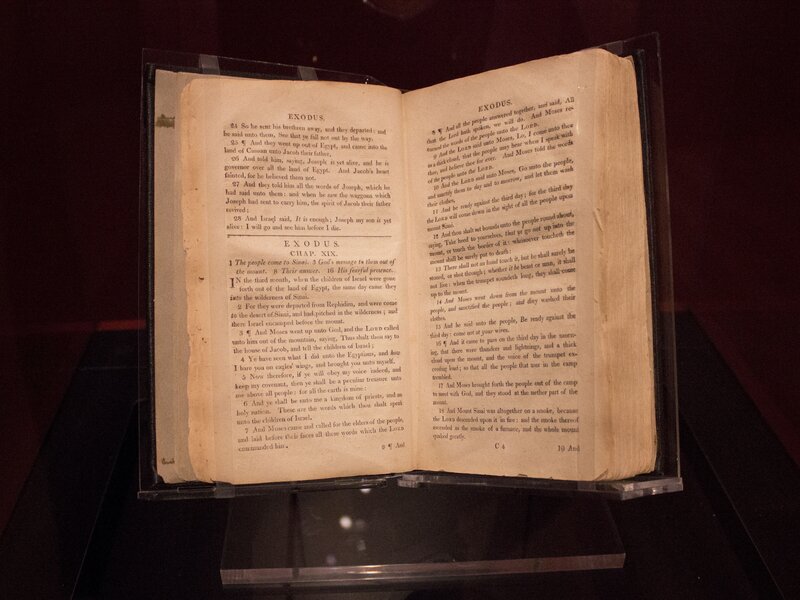
The Slave Bible of 1807


At the heart of the Demerara slave rebellion of 1823 is the story of the Congregationalist missionary John Smith.  Smith arrived at Le Resouvenir Estate in what  is now Guyana in 1817, and was warmly welcomed there. The authorities, however, warned him not to teach the local people, i.e. the slaves, to read. Otherwise, he would be banished. In the event, his preaching of the freedom that comes from knowing Christ was taken rather more literally than he perhaps intended, leading to an insurrection in August of 1823. The story of Smith’s arrest and trial, and his death in prison are well known, and caused outrage in the British Parliament. Some might think that the outrage was caused not so much by a new high moral ground as the Colonial Office’s increasing attempts to tame local legislatures! Two things are notable here.

The first is that the Christian gospel (and the Biblical narrative) is a revolutionary text, which governments have sought unsuccessfully to tame over the centuries. Three hundred years before, Martin Luther had written The Freedom of a Christian, which led disaffected German peasants in economic difficulty to rise up in the so-called Peasants’ War of 1524. Luther, strikingly, then retaliated by telling the peasants that they didn't really count, in his virulent treatise ‘Against the Robbing and Murdering Hordes of Peasants.’ The text may be revolutionary, but even its prime interpreters regularly spiritualize what is a holistic message of release from all forms of bondage, physical and spiritual.

The second notable fact is that teaching people to read (which Christian missionaries have done for centuries) is a subversive act, and the authorities in slave-owning territories understood this well. At first, the Bible was controlled in the West by being kept in the increasingly academic medium of Latin. Translation was forbidden, and when John Wycliffe and others illegally produced an English text, the proof of the pudding was the rise of popular Christianity that despised the authorities (ecclesiastical and political). They quickly applied the message of Jesus to their own straitened circumstances. Paulo Freire’s conscientization programme applied the same liberative principle in Brazil in the 20th century to great effect. There is a sense in which it doesn't much matter what people read as long as they can read for themselves. But when those who learn to read are given the most revolutionary text of all, trouble tends to break out.

This brings us to the headline document , the so-called Slave Bible of 1807. It is worth noting first of all that it is not presented as a Bible but as a compendium of Bible texts, and we need to be careful how we describe it. The actual title is Parts of the Holy Bible, selected for the use of the Negro Slaves, in the British West-India Islands. It does not attempt to present a truncated Bible in the way that Marcion did in the 2nd century CE, adapting it to his theological views. That said, it does give us a ‘canon within a canon’, a selection of the parts of the Bible that are deemed fitting for the audience. All Christians do this (as do all people of the Book). It is instructive to ask why certain parts of the Bible never get preached on in our churches. The editor of this volume is giving us a lectionary. So far, so good.

I can’t tell from the article who made the selection, but I would imagine that it comes out of the Church of England stable, the stable that was always most in cahoots with the slave-owning classes, and so perpetuated the status quo. It is not an innocent text! And here we can continue the story with the foundation of the Anglican diocese of Jamaica with Honduras in 1824 and its first bishop, Christopher Lipscomb. We are told that he did not think that he could encourage the education of slaves until public opinion paved the way, the classic case of the Christian trapped in his own cultural convenience. One cannot imagine that Lipscomb was blind the significance of his opinions.

One of the chief aims of the foundation of the Diocese was to prepare the slaves for eventual emancipation, and the Jamaican Legislative Council could not be counted on to do this. The Nonconformists were suspect and their missionary societies financially limited. And here’s the real point. The Church of England was more acceptable to the planters because it taught the principles of ‘obedience’ alongside the gospel message of ‘freedom’. In other words, your soul may be free but your body is still in hock to your owner. And even though education was being grudgingly promoted, the Jamaican slave code of 12/1826 prohibited dissenting preachers from holding meetings from sunset to sunrise, or receive pay from slaves for religious instruction.

In sum, this extraordinary text on display in the Museum of the Bible in Washington DC highlights the power of the biblical narrative, when read by oppressed people, to create a new redeemed imagination in which freedom is a divinely offered right. Recognizing this, those who seek to oppress tend to tame the Biblical text by the withdrawal of the rights of education, though it was no longer possible  by the 19th century to put the Biblical cat back in the bag. The 16th Reformations had put paid to that possibility. My final observation is that at stake here is who holds the right of interpretation: the theologians, the church authorities, or the readers. The Bible is not in and of itself an oppressive text, but it is up to us to ensure that it is read as a message of freedom, not of continued abuse and servitude.

Adrian Chatfield

16th December 2018


Jill and Adrian Chatfield's Christmas letter 2018

2018 has been a reminder for us that though life has its routines, life itself is rarely routine. It began predictably enough with a final trip in our old caravan to the banks of the Thames at Chertsey, in freezing temperatures. Though we miss it, it's lovely to have central heating and a toilet in the (nearly) new Lunar Ariva, and so far we've taken it to Anglesey, to Dorset and to Derbyshire.

At the end of July, we flew to the Alps for a long-awaited week with Adrian's sister Clare and her husband Didier. We got in two days excellent walking, and then all hired electric mountain bikes to do some off-roading. It was exhilarating until Jill came off on a corner, and the bike landed on her leg. It seemed to be a very bad sprain, and she managed to cycle the 20 km. or so back with her poorly ankle. Plan B then was for the three to continue walking while Jill explored the local town. That evening, we had a phone call to say that Jill's dad had fallen again, and was not expected to live long.

So we sadly left and flew back, missing our connection in Düsseldorf in the process. In the event, Jill's dad lived until August 22nd, and died peacefully that evening. Meanwhile, Jill was walking with crutches fairly well, but it twinged badly if she turned. An X-ray showed a clean break, so Fracture Clinic put her in an airboot. By the time the funeral came, Jill was able to conduct the service using only an arm crutch, but it was a stressy time. We are glad that Ray is no longer struggling: he had grown very tired of life, and conversation had more or less dried up by the time he died at the good old age of 91.

Since then, it's been strange to have so much time for ourselves, with no driving in and out of Nottingham to his care home. As always, bereavement is a funny mix of emotions, but life is beginning to take a new shape.

All of this has curtailed Jill's hospital ministry. She has been volunteering at the Nottingham Hospitals for some time, and is now on the bank of chaplains. On Christmas Day she will be back on the wards taking communion to those who have not been discharged, and hopes to pick up the pieces in 2019. Adrian continues to offer spiritual direction and lead weekends and retreats, three of which Jill was involved in: the Church of Ireland Curates' retreat in April (County Laois); Linby and Papplewick parish weekend in July (Dovedale) and the annual Launde Abbey Advent retreat, which we led together at the end of November.

So the end of the year looms. We're looking forward very much to catching up with Michael, Helen, Hannah and Naomi, with whom we were supposed to spend a holiday in August. The ankle put paid to that, though we were able to see them briefly at the Royal Albert Hall when Michael was singing with his choir, the wonderfully named London Welsh Male Voice Choir. Rachel, Dave, Charlotte and Lucy live seven miles away, so we do see them with some regularity! Then in January we go to County Donegal in the Republic of Ireland for two and a half weeks looking after the most north-westerly parish in Ireland.

In the midst of the political turmoil, bleak news and economic uncertainty, we are very grateful for the grace of God made known to us in Jesus Christ, and the quiet peace and assurance that this gives us. We've been glad to pray for many of you over the year, and if you'd like us to continue doing so, you only need ask! In the meantime, we wish you all a holy Christmas, and an approaching new year of hope and peace.

Adrian and Jill
63 Wesley St
Ilkeston
DE7 8QW

adrian.chatfield@btinternet.com
jill.chatfield@btinternet.com


Adrian and Jill Chatfield's Christmas letter 2021

The year started a little inauspiciously, as Jill had broken her knee in a freak bicycle accident in late November 2020. She was given the c...