Friday, 30 August 2019

The end draweth nigh: Brexit?


It came to me in a moment of idle speculation: October 31st is the end of the world, at least as we know it. I’d be hard pressed to foretell the outcome. Political commentators predict chaos if they are remainers, or a little pain for a better world (exiters). The millennium – and dire consequences for unbelievers – has been prophesied for the past 2000 years and longer. Norman Cohn in his classic ‘The Pursuit of the Millennium’ unfolds the European predilection for a politics of disaster leading to a new golden age, often with the elimination of those with uncomfortably distinct views.

On the one hand, the truth is that November 1st will probably be a dull and rainy day. November as usual, then. What none of us can tell is the consequence of reversing an incompletely thought through political project: the European Union. Born out of the horror of European and global conflict, it always had a millennial tone: the new age dawns. It also had a crusading tone: together we can correct the imbalance of power, lest America and the USSR dominate the global economy.

On the other hand, it is the child of 21st century populist politics, bearing the stamp of nationalist identity, fear of the global project, terror at the invasion of the barbarians, all cloaked by the illusion of this thing we call ‘sovereignty’. Fortunately, few people I know think that our leaders are Messiahs. We probably consider them the least worst option. What I hope for is that the doors of political debate remain open without rancour. It’s the bitterness and polarized anger that I fear the most.

So what am I waiting for? Perhaps most of all for the waiting time to be over, and for us to get on with decisions that have been taken. I’m hoping for no one to say ‘I told you so’, remainer or exiter. I’m longing for people to learn to go on talking to each other more graciously than even normally courteous Christians are doing at the moment. I hope, and pray.

Tuesday, 25 December 2018

Afghanistan: first country on the UN list!

Predictably, what I know about Afghanistan is summed up in headlines like France24’s Christmas 2018 item: Gunmen storm government building in Afghan capital, dozens dead. It’s very difficult to get past such news, and it would be offensive to ignore the endless violence of the ongoing civil war. Even here, it’s difficult, because it’s about much more than radical Islam. It takes time to dig deeper, and headline news reading is just the thing in our instant society.

Even the local news agencies like Pajhwok Afghan News strike a similar note, but at least they take us past the two-dimensional reporting that consigns certain countries and societies to the refuse heap of history. As I pray for this country, here are some of the alternative narratives that I would like to embrace:

Alongside the ongoing discrimination against girls in Afghan education, there are stories of a shifting centre of gravity:

Now of course I could provide an alternative list, of schools torched, of teachers threatened, of girls excluded and of scholarship programmes which further the ends of male-dominated education. But doing this has made me wonder whether where I focus my attention might constitute an element of hope, and faith. Certainly, it changes the tenor of my prayer.

I could go on with a load of other categories, but 'reconstruction' was another fruitful field, with the Italian entry being unexpected (and revealing my prejudice about the current state of Italian governance!)


The other sobering thought that occurred to me, and does regularly, is how much the current state of Afghanistan has been caused by imperial pretensions, British, Russian, Pakistani, and now Far Eastern. We play games with weak and struggling countries, and then shake our heads and tut when the politics explodes in our faces. So my final prayer for Afghanistan is that those who invest in it might do so out of humility, compassion, and a desire for peace. Happy Christmas!


Tuesday, 18 December 2018

The Slave Bible of 1807


At the heart of the Demerara slave rebellion of 1823 is the story of the Congregationalist missionary John Smith.  Smith arrived at Le Resouvenir Estate in what  is now Guyana in 1817, and was warmly welcomed there. The authorities, however, warned him not to teach the local people, i.e. the slaves, to read. Otherwise, he would be banished. In the event, his preaching of the freedom that comes from knowing Christ was taken rather more literally than he perhaps intended, leading to an insurrection in August of 1823. The story of Smith’s arrest and trial, and his death in prison are well known, and caused outrage in the British Parliament. Some might think that the outrage was caused not so much by a new high moral ground as the Colonial Office’s increasing attempts to tame local legislatures! Two things are notable here.

The first is that the Christian gospel (and the Biblical narrative) is a revolutionary text, which governments have sought unsuccessfully to tame over the centuries. Three hundred years before, Martin Luther had written The Freedom of a Christian, which led disaffected German peasants in economic difficulty to rise up in the so-called Peasants’ War of 1524. Luther, strikingly, then retaliated by telling the peasants that they didn't really count, in his virulent treatise ‘Against the Robbing and Murdering Hordes of Peasants.’ The text may be revolutionary, but even its prime interpreters regularly spiritualize what is a holistic message of release from all forms of bondage, physical and spiritual.

The second notable fact is that teaching people to read (which Christian missionaries have done for centuries) is a subversive act, and the authorities in slave-owning territories understood this well. At first, the Bible was controlled in the West by being kept in the increasingly academic medium of Latin. Translation was forbidden, and when John Wycliffe and others illegally produced an English text, the proof of the pudding was the rise of popular Christianity that despised the authorities (ecclesiastical and political). They quickly applied the message of Jesus to their own straitened circumstances. Paulo Freire’s conscientization programme applied the same liberative principle in Brazil in the 20th century to great effect. There is a sense in which it doesn't much matter what people read as long as they can read for themselves. But when those who learn to read are given the most revolutionary text of all, trouble tends to break out.

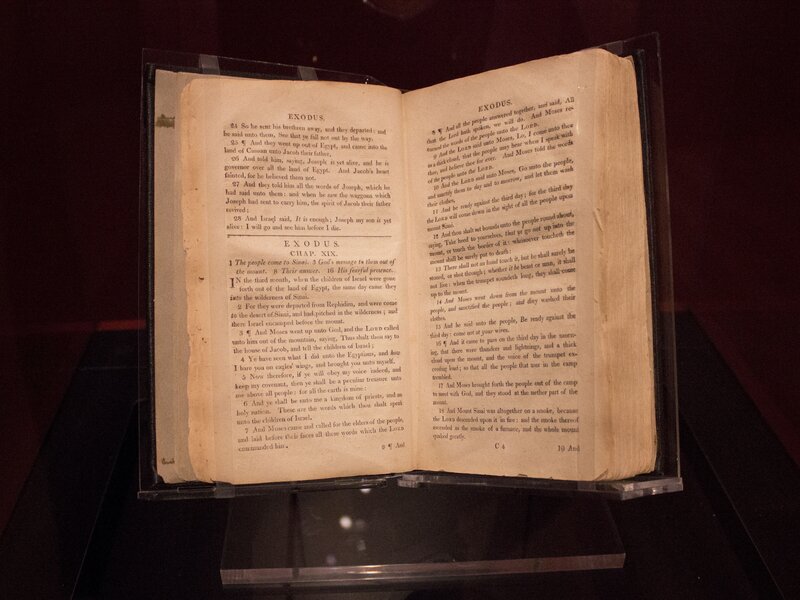
This brings us to the headline document , the so-called Slave Bible of 1807. It is worth noting first of all that it is not presented as a Bible but as a compendium of Bible texts, and we need to be careful how we describe it. The actual title is Parts of the Holy Bible, selected for the use of the Negro Slaves, in the British West-India Islands. It does not attempt to present a truncated Bible in the way that Marcion did in the 2nd century CE, adapting it to his theological views. That said, it does give us a ‘canon within a canon’, a selection of the parts of the Bible that are deemed fitting for the audience. All Christians do this (as do all people of the Book). It is instructive to ask why certain parts of the Bible never get preached on in our churches. The editor of this volume is giving us a lectionary. So far, so good.

I can’t tell from the article who made the selection, but I would imagine that it comes out of the Church of England stable, the stable that was always most in cahoots with the slave-owning classes, and so perpetuated the status quo. It is not an innocent text! And here we can continue the story with the foundation of the Anglican diocese of Jamaica with Honduras in 1824 and its first bishop, Christopher Lipscomb. We are told that he did not think that he could encourage the education of slaves until public opinion paved the way, the classic case of the Christian trapped in his own cultural convenience. One cannot imagine that Lipscomb was blind the significance of his opinions.

One of the chief aims of the foundation of the Diocese was to prepare the slaves for eventual emancipation, and the Jamaican Legislative Council could not be counted on to do this. The Nonconformists were suspect and their missionary societies financially limited. And here’s the real point. The Church of England was more acceptable to the planters because it taught the principles of ‘obedience’ alongside the gospel message of ‘freedom’. In other words, your soul may be free but your body is still in hock to your owner. And even though education was being grudgingly promoted, the Jamaican slave code of 12/1826 prohibited dissenting preachers from holding meetings from sunset to sunrise, or receive pay from slaves for religious instruction.

In sum, this extraordinary text on display in the Museum of the Bible in Washington DC highlights the power of the biblical narrative, when read by oppressed people, to create a new redeemed imagination in which freedom is a divinely offered right. Recognizing this, those who seek to oppress tend to tame the Biblical text by the withdrawal of the rights of education, though it was no longer possible  by the 19th century to put the Biblical cat back in the bag. The 16th Reformations had put paid to that possibility. My final observation is that at stake here is who holds the right of interpretation: the theologians, the church authorities, or the readers. The Bible is not in and of itself an oppressive text, but it is up to us to ensure that it is read as a message of freedom, not of continued abuse and servitude.

Adrian Chatfield

16th December 2018


Jill and Adrian Chatfield's Christmas letter 2018

2018 has been a reminder for us that though life has its routines, life itself is rarely routine. It began predictably enough with a final trip in our old caravan to the banks of the Thames at Chertsey, in freezing temperatures. Though we miss it, it's lovely to have central heating and a toilet in the (nearly) new Lunar Ariva, and so far we've taken it to Anglesey, to Dorset and to Derbyshire.

At the end of July, we flew to the Alps for a long-awaited week with Adrian's sister Clare and her husband Didier. We got in two days excellent walking, and then all hired electric mountain bikes to do some off-roading. It was exhilarating until Jill came off on a corner, and the bike landed on her leg. It seemed to be a very bad sprain, and she managed to cycle the 20 km. or so back with her poorly ankle. Plan B then was for the three to continue walking while Jill explored the local town. That evening, we had a phone call to say that Jill's dad had fallen again, and was not expected to live long.

So we sadly left and flew back, missing our connection in Düsseldorf in the process. In the event, Jill's dad lived until August 22nd, and died peacefully that evening. Meanwhile, Jill was walking with crutches fairly well, but it twinged badly if she turned. An X-ray showed a clean break, so Fracture Clinic put her in an airboot. By the time the funeral came, Jill was able to conduct the service using only an arm crutch, but it was a stressy time. We are glad that Ray is no longer struggling: he had grown very tired of life, and conversation had more or less dried up by the time he died at the good old age of 91.

Since then, it's been strange to have so much time for ourselves, with no driving in and out of Nottingham to his care home. As always, bereavement is a funny mix of emotions, but life is beginning to take a new shape.

All of this has curtailed Jill's hospital ministry. She has been volunteering at the Nottingham Hospitals for some time, and is now on the bank of chaplains. On Christmas Day she will be back on the wards taking communion to those who have not been discharged, and hopes to pick up the pieces in 2019. Adrian continues to offer spiritual direction and lead weekends and retreats, three of which Jill was involved in: the Church of Ireland Curates' retreat in April (County Laois); Linby and Papplewick parish weekend in July (Dovedale) and the annual Launde Abbey Advent retreat, which we led together at the end of November.

So the end of the year looms. We're looking forward very much to catching up with Michael, Helen, Hannah and Naomi, with whom we were supposed to spend a holiday in August. The ankle put paid to that, though we were able to see them briefly at the Royal Albert Hall when Michael was singing with his choir, the wonderfully named London Welsh Male Voice Choir. Rachel, Dave, Charlotte and Lucy live seven miles away, so we do see them with some regularity! Then in January we go to County Donegal in the Republic of Ireland for two and a half weeks looking after the most north-westerly parish in Ireland.

In the midst of the political turmoil, bleak news and economic uncertainty, we are very grateful for the grace of God made known to us in Jesus Christ, and the quiet peace and assurance that this gives us. We've been glad to pray for many of you over the year, and if you'd like us to continue doing so, you only need ask! In the meantime, we wish you all a holy Christmas, and an approaching new year of hope and peace.

Adrian and Jill
63 Wesley St
Ilkeston
DE7 8QW

adrian.chatfield@btinternet.com
jill.chatfield@btinternet.com


Thursday, 7 December 2017

Jill and Adrian Chatfield – Christmas Letter 2017

We have lost count of the number of conversations that we have had this year about what ‘retirement’ means, and the word grows more meaningless by the month! We don’t like the Portuguese ‘aposentado’ with its hints of ‘sitting down’ – not much chance of that! Our favourite is the Spanish ‘jubilado’ – from the Biblical idea of jubilee. You can work it out for yourselves.

Life on the street in Cotmanhay is such fun. We have no fence and a grassy space in front of the house, where we have had many brief and a few significant conversations about life, illness, death, God, sexuality, divorce and caravans. Both the Midlands context and the so-called working-class environment mean that people are refreshingly open and accept us for who we are, while being rightly cautious about deep trust. And as for worrying about the Oxbridge label, it’s been refreshing to be asked where Cambridge is.

The shape of the year has in some ways been determined by Jill’s Dad’s failing health. We came back a week early from French holidays because he’d fallen and been hospitalized. After rehab, everyone agreed that he was not strong or mobile enough to go back home, and he’s now living in a good care home in Carrington, a suburb of Nottingham. Suffice to say that he’s accepting of the change, but quite troubled, and struggles with life. We visit regularly, and are working hard to get him in his wheelchair to us for Boxing Day and for his 91st birthday on 30th December.

We helped out in St Nic’s in the centre of Nottingham until Easter, and made some good friends. Thank you! We are settled for now in a small and welcoming congregation at St Laurence, Heanor, part of a team of four churches in the exotic locations of Marlpool, Aldercar and Langley Mill. This too is part of settling into an area which is very close to where both of our families come from.

Jill has been volunteering with the chaplaincy team at A&E in the Queen’s Medical Centre in Nottingham, and has now also been signed up as a bank chaplain. It remains to be seen how much call-out she will do: it’s taken an unconscionable length of time to be interviewed and do all the paperwork. Adrian, for his part, is busy with spiritual direction and conducting retreats. He’s currently taking bookings for 2019, and he and Jill are looking forward specially to leading the Advent retreat 2018 at Launde Abbey together.

We’ve had good breaks in Snowdonia and Nidderdale, as well as three excellent weeks caravanning in France. It was special, too, to go back to France at the end of September for Adrian’s niece wedding reception, and a great opportunity to catch up with his two sisters.
Adrian has taken to running in a big way, and has now completed 9 half-marathons and five marathons over the years. Jill goes regularly to the gym, and has added badminton to her range of exercise and sport. Her knees give her regular trouble, but it’s unpredictable and so she’s not yet sure how to take it forward.


Those of you who don’t know our family can skip this bit (!), but Michael and Helen are based now at RAF Odiham, with Michael currently on RAF placement in the Falkland Islands. So Helen, Hannah and Naomi fly out there to spend Christmas with him and the penguins. Hannah (17) is doing A Levels and applying to a range of universities including Cambridge, York and Nottingham. Naomi (15) is moving towards the GCSE season. Helen has stopped teaching, frustrated by political and bureaucratic pressures, and is now Youth Officer for her local churches.

Rachel continues as a senior occupational therapist in the NHS, with all the joys and sorrows of that organization. Dave has settled well into being a civil servant i.e. working for Broxtowe Borough Council as an electrician in their housing department. Charlotte (13) is in her third year of secondary school, so GCSE choices are around the corner, while Lucy (10) is having a final carefree (?) primary school year.


We love hearing from some of you, either by snail mail or through FB during the year, and receiving the annual letters. They are much appreciated. We do pray for many of you, and if you ever have something special you’d like us to pray for, you only have to ask. Our prayer in a troubled and unpredictable world is for integrity among our leaders and a reduction in corruption among the ruling castes of the nations. It’s a sombre time, and so we end with one of Malcolm Guite’s sonnets from his Sounding the Seasons, called simply ‘Refugee’:

We think of him as safe beneath the steeple,
Or cosy in a crib beside the font,
But he is with a million displaced people
On the long road of weariness and want.
For even as we sing our final carol
His family is up and on that road,
Fleeing the wrath of someone else’s quarrel,
Glancing behind and shouldering their load.
Whilst Herod rages still from his dark tower,
Christ clings to Mary, fingers tightly curled,
The lambs are slaughtered by the men of power,
And death squads spread their curse across the world.
But every Herod dies, and comes alone
To stand before the Lamb upon the throne.

Love and blessings to all

Jill and Adrian


Tuesday, 14 November 2017

Small change, rich story

When I arrived in Brazil in 1957, this was the smallest banknote, 1 cruzeiro, and it was worth about half a penny. There were millions of them in circulation; they were the small change for bus and tram travel, and they stank. I can still close my eyes and smell them. I have never seen a crisp one. I think they went out of circulation sometime before we left in 1964. By then, a pound was 5000 cruzeiros, so they were pretty useless!

It’s only in later life that I have stopped to look at the artwork, and it carries a fascinating story, of the ‘Brazilian Nelson’, commemorated here and in a coin from 1936. The figure on the obverse is Joaquim Marques Lisboa, Marquis of Tamandaré (1807-1897), an officer in the Brazilian navy at the time it was fighting for independence from Portugal. He eventually rose to the rank of Admiral. As Patron of the Navy to this day, a kind of secular saint, his birthday is observed as Sailors’ Day [Dia do Marinheiro].  

His Portuguese father was the port manager of Rio Grande, one of the most southerly ports in the country and state capital of Rio Grande do Sul from 1835 to 1845. He and his brother Henrique accompanied their father on his visits on board ships in port, which is presumably where he gained his love of ships and the sea. When he was seven, his brother enrolled in the Academia Real, and he joined the navy himself in 1822, the year of Brazil’s independence from Portugal. 

His first posting in 1823 was on the frigate Niterói, then under the command of the English mercenary James Norton. This itself is interesting, as the United Kingdom was in the 19th century very supportive of independence movements in South America, mainly because the Spanish Empire was a major natural competitor!  In this role, he took part in a number of battles, including one against the northeastern provinces [Bahia, Maranhão, Pará, Piauí e Cisplatina] which had remained loyal to Portugal.

He returned to Rio de Janeiro and joined the Naval Academy, there studying English among other subjects. Meanwhile, the War of Independence continued, with rebellions against the newly indepedent nation breaking out sporadically, notably the formation of an Equatorial Confederation [Confederação do Equador]. In July 1824, he fought against this group on Admiral Thomas Cochrane’s flagship Pedro Primeiro. Cochrane was yet another British mercenary naval officer. In February 1825, he was promoted to Second Lieutenant, at the tender age of 18. 

Further battles followed against those who sought to overthrow the fledgling monarchy, especially in the Regency after Dom Pedro I’s abdication in 1831.

By 1840 he was captain of a frigate, and in 1844 he was appointed commander of the Central Naval Region. In that role, he went to England to collect a new corvette, the Dom Afonso (the first under sail and steam in the navy), under orders from Dom Pedro II. In 1859, he was back in Europe again with his wife, recruiting sailors and technicians, and commissioning 10 cannons from French and British manufacturers. Not long afterwards, he was commander of the naval division that took the Emperor and his wife to Pernambuco, to the town of Tamandaré, where there had been an uprising.

As a result of this, in 1860 he received the title of Baron of Tamandaré, which appears on the banknote’s obverse. In 1864, he was deeply involved in the longest of Brazil’s 19th century wars, the Paraguayan War. Following this, he was promoted to Admiral, and twenty years later, became Count, then Marquis, receiving the Order of the Rose.

He was clearly a notable man, of great dignity. One biographer describes him as ‘of a humble personality, who mixed with the slaves who were liberated by the Golden Law’. In the 19th century, this marks him out as a person of astonishingly liberal values.

He was also a staunch monarchist. He stood beside the Emperor in 1889 at the age of 82 during the overthrow of the monarchy, and asked the Emperor’s permission to fight back against the insurgency. The emperor, however, refused, and went into exile in France. In his will Tamandaré comments that the Emperor died in exile without honour, so he would like to be buried without any military honours whatsoever, in a simple grave with the marker ‘Here lies the old sailor’.


Monday, 12 December 2016

Urban art in Stellenbosch

This is a bit of a random blog, simply celebrating the creative spirit in one of South Africa's loveliest and safest cities. The sculpture of a cheetah, outside an exclusive gallery, is exquisite, capturing the speed, lightness, energy and concentration of the chase. Ironically, though, we find it in a part of the country where the wildlife has almost been wiped out apart from in exclusive game parks frequented by foreigners with the purchasing power to install the art and see the animals. The rarer the animal, the more valuable the sculpture. When the cheetah is extinct in the wild, I wonder whether the art will die with it? I'm not knocking the artist, but musing on the relationship between art and nature, and our desire to capture the beauty.

 Like many people, I want to touch and feel sculpture, so this strange fellow felt closer to me than the remote, aloof and highly-priced animal. The sculptor, Jean Theron Louw, portrays the old man Oupa Carlos musing on the planet that we have scarred, and wondering - at 3.23 a.m. - whether his life was egocentric or soul-centric. It's a little 'new age' and 'mother earth' and all that, but raises some of the same issues that I did about the cheetah above. "Did you care for mother earth?"

"I don't know whether I cared enough" is the honest answer, but I know I tread lightly through the land, and hurt when I see how scarred it is. But it's romantic in an unhelpful way to care for mother earth without caring for her children, and so often issues of ecology and issues of justice seem to be poles apart. For me, the next 'you can't be serious' poster is the prophetic warning. Ageless is the dream, instant is the mode of delivery, and it is of course available if you have enough money to purchase it. Sadly, it usually seems to involve botox. Pumped full of chemicals, I can neither smile nor frown any more, but at least the wrinkles that show that I am alive have been smoothed out in a chemical death. Now you know why I prefer to photograph old people who have 'let themselves go'. Such a negative phrase, which needs to be given a positive spin. They've let themselves go, they've let themselves live, without fear, without pretence.

If you ever read this blog, it's probably because you can't sleep, and I confess that it is little more than meandering thoughts about an unconnected series of photographs. Maybe that's what art is given us for, to provoke us to think, to live, to change. Let me know what you think!


Adrian and Jill Chatfield's Christmas letter 2021

The year started a little inauspiciously, as Jill had broken her knee in a freak bicycle accident in late November 2020. She was given the c...